How Tariffs Are Affecting Rehab Costs for Wisconsin Real Estate Investors in 2026
If you've priced a rehab project in 2026 and felt like the numbers looked different from what they did even a couple of months ago, you're right. They are different, and tariffs are a significant reason why.
For fix-and-flip investors and new-construction borrowers in southeastern Wisconsin, tariff-driven increases in material costs are significantly impacting budgets. We break down which materials are affected, what the data actually shows about cost increases, and what disciplined investors are doing to protect their margins.
Which Building Materials Are Affected by Tariffs?
The short answer is: most of the ones you use on every project.
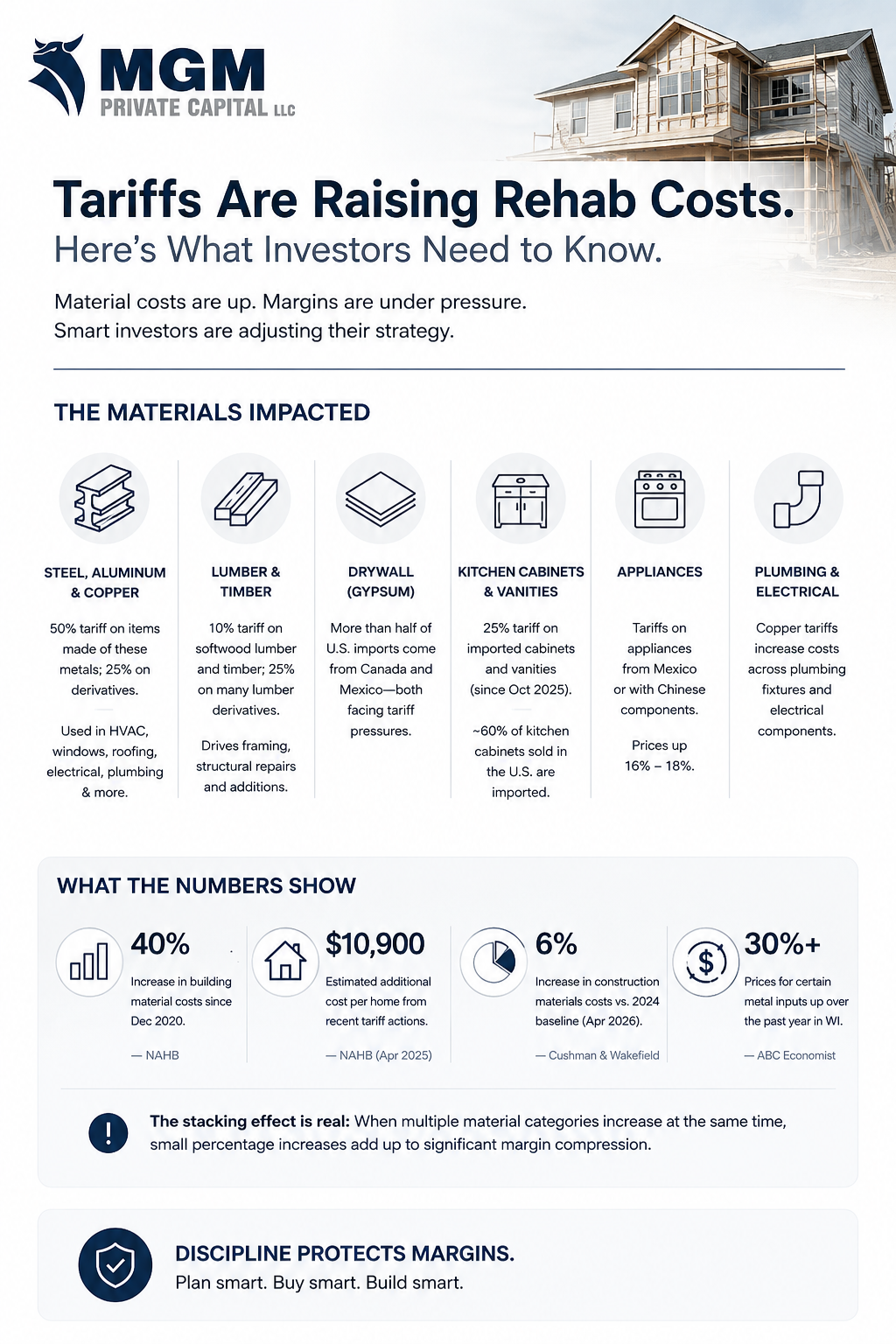
According to the Associated General Contractors of America, current tariff rates as of May 2026 include a 50% tariff on items made entirely or mostly of steel, aluminum, and copper, a 25% tariff on derivatives of those metals, and a 10% tariff on softwood lumber and timber, with various lumber derivatives subject to 25%.
That covers a lot of ground on a standard rehab. Steel and aluminum show up in HVAC ductwork, windows, structural elements, roofing, and electrical conduit. Lumber drives framing, structural repairs, and anything involving modified walls or additions. Copper runs through plumbing and electrical. Brookings Institution research notes that gypsum, used in drywall, is also exposed — more than half of U.S. gypsum imports come from Canada and Mexico, both subject to additional tariff pressures.
Kitchen and bathroom finishes took a separate hit. A 25% tariff on imported kitchen cabinets and bathroom vanities went into effect in October 2025. Roughly 60% of kitchen cabinets sold in the U.S. are imported, which means most investors doing a kitchen remodel are paying this tariff whether they select a budget or a premium product. On a wholesale cabinet package that ran $3,000 before the tariff, the pass-through now puts the cost between $3,750 and $4,200.
Appliances are also meaningfully higher. Tariffs on appliances manufactured in Mexico or containing Chinese components have pushed prices up 16% to 18% on common items including dishwashers, ovens, ranges, and microwaves.
What Do the Numbers Actually Show?
The National Association of Home Builders reports that the cost of building materials has already risen 40% since December 2020. Their April 2025 Housing Market Index survey found that builders estimate a typical cost impact from recent tariff actions at $10,900 per home, and more than 60% of builders reported higher costs directly attributable to tariffs.
Cushman & Wakefield's April 2026 analysis estimates that current tariff rates will result in a 6% increase in construction materials costs relative to a 2024 baseline, with total project costs rising an estimated 3%. At peak tariff levels in summer 2025, their estimate was a 9% materials cost increase, so some pressure has eased — but the baseline is still materially higher than pre-tariff conditions.
The stacking effect is where investors get caught off guard. The problem isn't any one line item — it's that almost every material category in a mid-to-heavy rehab is affected at the same time. Framing, structural work, plumbing, HVAC, kitchen finishes, and appliances are all running higher. A percentage increase that looks manageable on one item compounds quickly when five or six categories across the same project scope are all more expensive simultaneously.
This is also a Wisconsin-specific concern, not just a national one. The Daily Reporter's March 2026 analysis of Wisconsin construction cited economist Anirban Basu of Associated Builders and Contractors, who noted that "tariffs have put renewed upward pressure on materials prices," adding that "prices for certain metal inputs are up more than 30% over the past year" for the inputs most exposed to tariffs.
What Hasn't Changed — and Why That Matters
It's worth being clear about what tariffs don't change for fix and flip investors in Wisconsin.
ARV is still set by the market. Buyers don't pay more for a finished property because your rehab cost more. That means higher material costs compress margins from the cost side without any corresponding relief on the revenue side.
Holding costs still accumulate by the day. If tariff-related price volatility or material delays extend a project timeline, those extra weeks add loan interest, insurance, utilities, and taxes to your carry burden.
This is what experienced investors understand that first-timers often don't: budget overruns don't just cost more money, they cost more time, and time costs money too. A $5,000 materials overage on a kitchen is manageable. The same overage, combined with a four-week project delay, can easily turn into $12,000 or more in total margin impact when carrying costs are factored in.
How Disciplined Investors Are Responding
The investors managing this environment well are making adjustments in how they plan and buy, not in whether they invest.
Build the tariff environment into your contingency. The standard 10-15% rehab contingency may not be sufficient for projects with significant scope in cabinets, appliances, or structural steel. For kitchen-heavy renovations or anything involving HVAC replacement and structural work, a 15-20% contingency is more defensible right now.
Get material quotes before you commit. Locking in pricing on high-tariff items before closing — or at minimum, before submitting your offer — removes a major variable from the budget. Contractors who specialize in residential rehab are increasingly locking in supply agreements in advance for exactly this reason.
Plan ARV conservatively. If material costs are higher, the temptation is to push ARV slightly to make the deal work on paper. That's the wrong response. Conservative ARV assumptions built on current comps are your first line of margin protection.
Account for potential delays. Supply chain volatility doesn't just affect price, it affects availability and lead times. If a custom cabinet package or HVAC unit has an extended lead time, build that into your timeline and your carry cost estimate before the deal is done.
The Bottom Line Impact On Wisconsin Investors
Tariffs are a real cost factor in 2026 rehab budgets. They're not a reason to stop investing — southeastern Wisconsin's housing market remains one of the strongest in the country, with demand absorbing supply and prices continuing to rise. But they are a reason to budget more carefully, get quotes earlier, and build in appropriate contingency for the materials most exposed to tariff pressure.
The investors who continue to perform well in this environment are the ones who account for current conditions rather than the conditions they remember from 2024 or even 2025. The numbers have changed. Good planning accounts for that.
If you're analyzing a deal and want to pressure-test your rehab budget before committing, I'm happy to take a look. A conversation on the front end is the cheapest insurance you can buy on a flip.
————————————————————————-
Legal Disclaimer:
This article is provided for informational and educational purposes only and is not intended to constitute legal advice. Real estate regulations can be complex and situation-specific. Readers should consult with qualified legal counsel or a licensed attorney for guidance regarding their particular transaction or compliance obligations.
At MGM Private Capital, we actively support real estate investors across Southeastern Wisconsin with trustedcapital options and offer opportunities for capital partners to grow alongside us.