
Wisconsin Ranked #6. Here's What the Local Data Actually Shows.
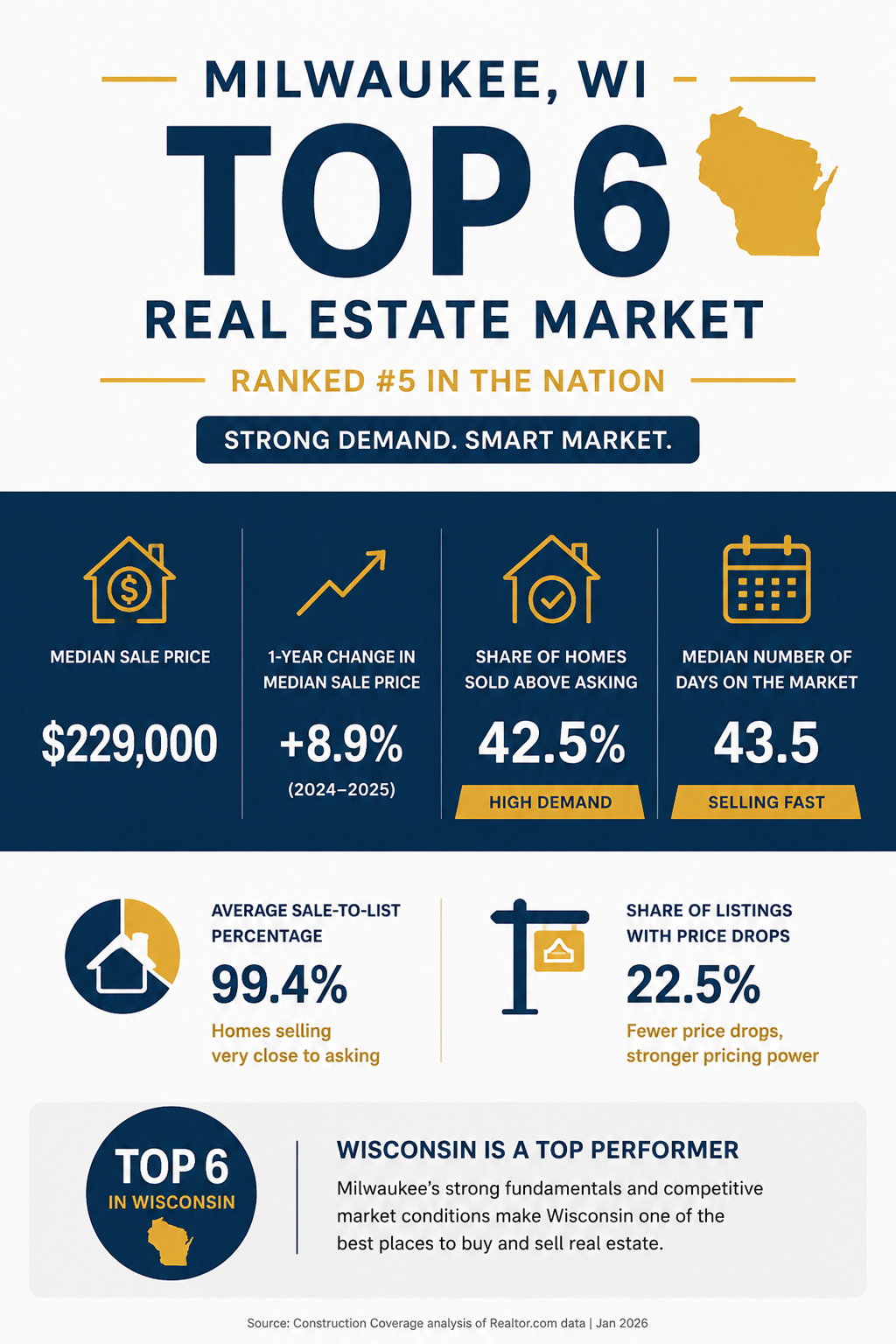
Wisconsin may have ranked as the #6 hottest real estate market in the country for 2026, according to Construction Coverage, but statewide rankings only tell part of the story. For real estate investors in southeastern Wisconsin, the question that actually matters is what's happening at the county and neighborhood level, because a property in Waukesha doesn't compete the same way as one in Wauwatosa or Milwaukee's north side.
This article breaks down the Q1 2026 Milwaukee metro housing market data by county, explains why inventory remains the defining constraint for local investors, and covers what being prepared looks like in a sub-three-month supply market. Prices are rising, listings are being absorbed almost as fast as they come on, and well-positioned properties are still drawing fast attention. Here's what the data actually shows and what it means for investors planning spring and summer projects in southeastern Wisconsin.
How Is the Milwaukee Metro Real Estate Market Performing in 2026?
According toQ1 2026 data from the Greater Milwaukee Association of Realtors, the average home sale price across the four-county area rose 5% to $457,448, and overall sales volume increased 2.1% year over year.
The county-level breakdown tells a more useful story.
Waukesha County was the standout, with new listings surging 29.9% in March alone and up 22.1% for the full first quarter, the strongest listing growth in the metro. Ozaukee County also posted solid gains. Milwaukee County, by contrast, ran softer, with sales trailing the broader metro trend for the quarter.
For investors, this matters. ARV assumptions need to be grounded in the county where the property actually sits, not the metro-wide average. A flip in Waukesha is not priced the same way as a flip in Milwaukee. Comps that cross county lines, or that don't account for school zone boundaries and neighborhood-level buyer pools, can distort your margin math before you've broken ground.
The broader message from the GMAR report was direct: the additional listings "were absorbed almost immediately" and there is "no downward pressure on prices." More supply is entering the Milwaukee housing market. Buyers are keeping pace with it.
Why Is Housing Inventory So Low in the Milwaukee Metro?
More listings are genuinely welcome news. But Milwaukee's supply picture remains structurally tight.
As of late 2025,Realtor.com ranked Milwaukee metro as having the lowest months of supply among the 50 largest metro areas in the country, just 2.7 months, compared to a national average of five months. That condition has improved only modestly heading into spring 2026, with the metro sitting around 2.9 months of supply as of March. That's still well below the five to six months typically associated with a balanced market.
Jake Krimmel, a senior economist at Realtor.com, explained that the low supply isn't just a product of homeowners holding on to their properties. There's also a construction dimension: relatively little new home construction occurs in the city of Milwaukee or its inner-ring suburbs, unlike cities and towns with open land and active development pipelines.
For real estate investors looking for fixer properties in southeastern Wisconsin, this context is essential. A well-located property that needs work in Brookfield, Shorewood, or Mequon draws interest from retail buyers who can't afford move-in-ready homes as well as from other investors running the same playbook. In a sub-three-month supply environment, the window between a property hitting the market and going under contract can close in 48 to 72 hours.
That is not enough time to start your financing conversation.
Additional Facts on the Current Market
Is the Milwaukee housing market still competitive for investors in 2026?
Yes. Despite modest increases in listings, the Milwaukee metro housing market remains highly competitive for investors. The Greater Milwaukee Association of Realtors reported that new listings in Q1 2026 were "absorbed almost immediately," with no downward pressure on prices. Months of supply sits around 2.9 months as of March 2026, well below the 5-6 months that signals a balanced market.
What is the average home sale price in the Milwaukee metro in 2026?
According to GMAR's Q1 2026 report, the average home sale price across the four-county Milwaukee metro area (Milwaukee, Waukesha, Ozaukee, and Washington counties) rose 5% year over year to $457,448.
Which county in the Milwaukee metro had the strongest real estate activity in Q1 2026?
Waukesha County led the four-county metro in listing growth, with new listings up 29.9% in March and 22.1% for the full first quarter of 2026, according to GMAR data. It posted the strongest listing growth in the metro area.
How does Milwaukee's housing supply compare to the national average?
As of late 2025, Milwaukee metro had the lowest months of supply among the 50 largest U.S. metro areas, at just 2.7 months, compared to a national average of five months. That gap has narrowed only slightly heading into spring 2026.
Why is it important to have financing in place before finding an investment property in southeastern Wisconsin?
In a market where well-priced properties go under contract in 48 to 72 hours, waiting until you've found a property to start your financing conversation puts you at a significant disadvantage. Investors with pre-arranged private lending in place can move quickly, submit stronger offers, and close faster — which matters to sellers who prioritize speed and certainty over top dollar.
What Does a Tight Market Mean for Fix and Flip Investors in Southeastern Wisconsin?
In this market, preparation is a competitive edge, and it's one that's easy to underestimate until you've lost a deal to someone who was better prepared.
The investors who close the best spring deals in southeastern Wisconsin share a common characteristic: their financing is lined up before the right property appears. They know their buy box, they've pressure-tested their ARV assumptions against current comps, and when something that fits hits the market, they can move in days, not weeks.
Spring is a compressed window in Wisconsin. That makes April and May productive, but also makes them unforgiving for investors who aren't positioned. Sellers don't wait for approvals to clear. And when two investors are competing for the same fixer property, the one with stronger financing almost always wins.
Sellers, particularly estate sales and motivated sellers looking for a clean, fast close, respond to conviction. Pre-arranged financing from a private lender in southeastern Wisconsin is what that conviction looks like on paper.
If you're planning a spring project, or you want to be ready when the right opportunity surfaces, get your financing conversation started now. A quick call on the front end can save a lot of stress once you're under contract, and I'm always happy to look at a deal with you before you commit.
————————————————————————-
Legal Disclaimer:
This article is provided for informational and educational purposes only and is not intended to constitute legal advice. Real estate regulations can be complex and situation-specific. Readers should consult with qualified legal counsel or a licensed attorney for guidance regarding their particular transaction or compliance obligations.
At MGM Private Capital, we actively support real estate investors across Southeastern Wisconsin with trustedcapital options and offer opportunities for capital partners to grow alongside us.